
Address: 1107 Christo Rey Street, Santa Fe, NM, 87501
Access: (505) 983-8528
By Audra Bellmore – January 14, 2024 / July 20, 2025

Cristo Rey stands on the lower end of the Upper Canyon Road on the east side of Santa Fe. The Archdiocese of Santa Fe hired local architect John Gaw Meem to design the Spanish Pueblo Revival style, cruciform-plan church in 1939 to mark the 400th anniversary of Coronado’s exhibition through the Southwest. It is constructed of 150,000 to 180,000 adobe bricks supported by a concrete foundation and structural steel frame that bears its massive dimensions measuring 125 feet long, 40 feet wide, and 33 feet high. It is considered the largest adobe church in the United States.


Cristo Rey’s design derives from a collection of Spanish mission churches found throughout New Mexico. Its double towers echo those of Acoma Pueblo’s San Estevan del Rey church. Its balconied front façade is reminiscent of Trampas’ San José de Gracia church. Its 222 carved vigas, supported by sets of carved corbels, made from lumber hauled down from the Sangre de Cristo mountains crowned the massive walls and supported the roof.


Cristo Rey’s construction was a community endeavor. Over 100 local men made the adobe bricks, mixed water from the nearby Acequia de Los Lopez with earth excavated from the church site. The men worked hard for $2 per day/five days per week, paid by the Archdiocese. Many volunteered their time on Saturday, because the church served their neighborhood and meant parishioners no longer needed to endure the long walk to St. Francis Cathedral. The demanding work generated a magnificent treasure that continues to serve the community.
Cristo Rey is a fitting monument for an extraordinary work of art. A nine-foot-thick adobe wall at the west end of the sanctuary supports the Reredos of Our Lady of Light, an historic and inspiring altarpiece, lit by a set of clerestory windows set above the sanctuary.
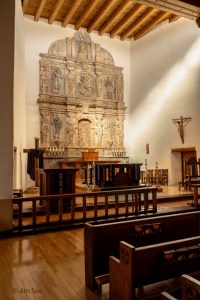
In 1760, retiring Spanish Governor and Capitan General of New Mexico, Francisco Antonio Marín del Valle, commissioned the construction of a military chapel called La Castrense, or Church of our Lady of Light, on the south side of the Santa Fe Plaza. Marín del Valle and his wife, María Ygnacia Martinez also funded an immense stone retablo for the church’s central decoration, completed in 1761 by Spanish military engineer, cartographer and sculptor, Bernardo de Miera y Pacheco. This rare Spanish Colonial sculptural relief was later moved to its resting place at Cristo Rey.
The reredos was carved in local white, volcanic limestone, quarried near Pojoaque, New Mexico by artisans brought from Zacatecas, Mexico. Standing 18 feet tall by 14 feet wide, its impressive form is set into Cristo Rey’s east-facing nave. Its three sections are separated by bulbous columns incorporating busts and caryatids (female figures). The art work’s imagery is based upon Renaissance sculptural representations. Its panels include a central image of St. James on horseback with a sword, flanked on either side by depictions of St. John Nepomuk holding a cross and a palm frond, and another of St. Anthony of Padua with the Holy Child and a tree. Above St. James, another central panel features a seated Mother and Child. Below St. James, a carving of Our Lady of Light, which once sat at the entrance to La Castrense, serves as a replacement for a lost oil painting of Our Lady of Light. Panels depicting St. Joseph and St. Ignatius Loyola represent the competing interests of the Franciscan and Jesuit orders in New Mexico. Two oval tablets positioned at the bottom of the reredos mark the names of the donors, “Señor Don Francisco Antonio Marín del Valle, Gobernador y Capitán General de Este Rein y de su esposa Dona María Ygnacia Martinez de Ugarte Ano Cristiano 1761.”
After the occupation of Santa Fe by the American Army in 1846, the La Castrense chapel fell into disuse. Archbishop Jean-Baptiste Lamy, in need of property to build schools for local boys and girls, negotiated a practical deal with local landholder Don Simon Delgado. The valuable property on the Plaza, on which La Castrense stood, was exchanged for an extensive site to the southwest where Lamy built St. Michael’s School for Boys and Our Lady of Loretto School for Girls. Lamy removed the reredos and other artwork from La Castrense before it was demolished. He saved the reredos in a room in the parroquia, or parish church in Santa Fe, around which Cathedral Basilica of St. Francis was later constructed. When Lamy completed the cathedral in 1869, he continued to protect the reredos in a storage room, where it remained until Cristo Rey was completed in 1940, providing a fitting accompaniment for the magnificent and irreplaceable artwork.
Completed: 1940
Architect: John Gaw Meem
Contractor: Parishioners
Learn More:
References:
Bunting, Bainbridge. Early Architecture of New Mexico. University of New Mexico Press, 1976.
Bunting, Bainbridge. John Gaw Meem, Southwestern Architect. University of New Mexico Press, 1983.
Fitzpatrick, George. “The Church of El Cristo Rey: Old History in a New Home.” Albuquerque Journal April 18, 1976.
08/25/205
 The Guide to New Mexico Architecture
Leave a comment