
Other name: Santiago E. Campos United States Courthouse
Address: 106 Federal Place, Santa Fe, NM
Access: Public Courthouse open during business hours. Security screening is strictly enforced at entrance (south side)
By Audra Bellmore – January 14, 2024, Revised February 19, 2025

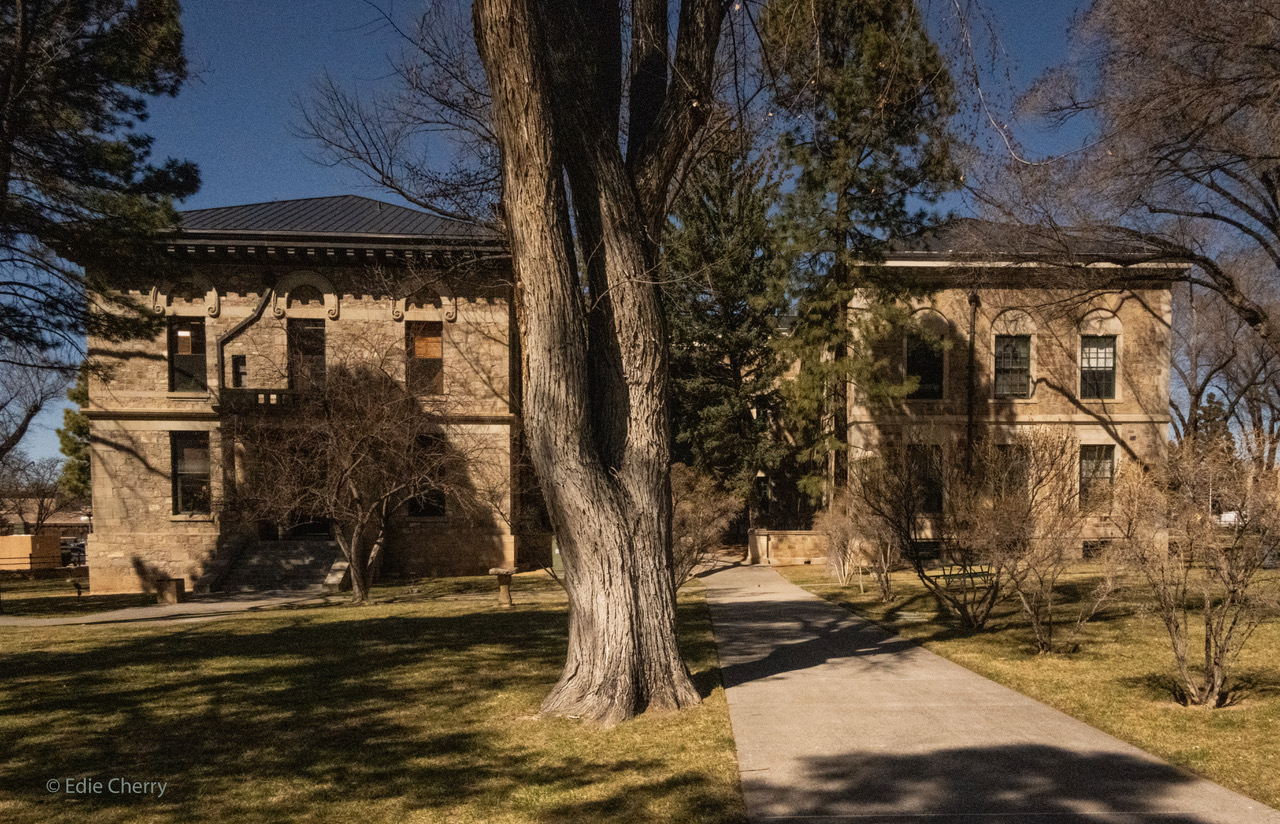
The impressive stone structure of the U.S. Courthouse stands two blocks north of the Palace of the Governors, Santa Fe’s historic municipal core. Its stature signifies a growth in the area’s population, the importance of the region as a governmental seat, and the related need for a stand-alone court during a period of transition in the developing district. The popular Greek Revival style design indicates a connection to the U.S. East Coast during New Mexico’s Territorial period.

The U.S. Courthouse sits on public land, ceded to the United States during the Treaty of Guadalupe Hidalgo in 1848. Initially constructed as the territorial capital, the building was reconsidered for use as a federal courthouse. Chief Justice Joab Houghton, a member of the U.S. Territorial Supreme Court, developed the original plans for the courthouse in 1851. The plans were formalized by Ammi B. Young, supervising architect of the U.S. Treasury. A $20,000 congressional appropriation paid for the property, once used as a town dump. In 1854, Congress granted another $50,000 to erect 1.5 stories, rising above a basement with rough stone excavated in the Hyde Park area north of downtown Santa Fe. A quarry in Cerrillos, New Mexico provided the dressed stone for the ornamental trim, lintels, and window frames. Work resumed in 1883 when the property hosted Santa Fe’s “Tertio-Millennial” celebration highlighting local Indigenous craft and culture, promoted by Territorial Governor L. Bradford Prince, which opened on July 2, 1833. The final three-story, 60’ x 140’ structure, completed in 1889 with an appropriation from Congress for $52, 000, included the circular stone wall and iron fencing surrounding the courthouse.
The U.S. Courthouse represents a time in Santa Fe when local architecture drew its inspiration from the East Coast following the American army’s conquest of the region. During New Mexico’s territorial period, local style consciously departed from Puebloan and Spanish antecedents as a way of further imposing U.S. rule. Employing the Greek Revival style for public legislative buildings became a common technique for establishing a link to the roots of democracy in Greece. The practical and necessary use of local materials helped regional identity merge with symbolism.

By 1907, Santa Fe experienced a revival of its own with the refurbishment of the Palace of the Governors (1610), America’s oldest public building in continual use. Archaeologists and members of the burgeoning artist colony, along with boosters from the local business community looking to promote the town for tourism, advanced an interpretation of regional Indigenous and Spanish building techniques within its historic core. The U.S. Courthouse survives as an important reminder of Santa Fe’s long and complicated history.
In 1884, the State of New Mexico erected a sandstone obelisk memorial for Kit Carson, a veteran of the Mexican-American War and the American Civil War, on the courthouse lawn. In 1929-30, a wing designed in the Greek Revival style was added that more than doubled the original size of the building. In 1938, New Deal artist Willard Nash painted a set of six large-scale murals depicting New Mexican landscapes in the north and south entrance halls.


Mural photos by Barbara Bernstein, www.LivingNewDeal.org (Click images to enlarge)
The U.S. Courthouse expanded to the north in 1926 with a 50’ x 140’ rectangular, stone-clad addition, nearly equal in size to the original structure. A substantial 20’ x 50’ vestibule links the extension to the primary building. The vestibule houses a magnificent, circular stone staircase stretching from the basement to the second floor. The staircase is integral to the building with its stone steps laid simultaneously with the building’s exterior wall. The step ends are articulated on the outside of the circular stone wall. This type of construction requires careful advance planning for the height of each riser to be consistent. Each step and all wall stones must be cut ahead of time and laid from bottom to top, with each stone resting on the edge of the stone below for a cantilevered effect. Stair rails and rail supports are secured to the interior stair wall, further enhancing the sense that the stair is supported entirely on one end.


The 1926 renovations also included an enlarged courtroom and a new east-facing entrance. The courtroom is a high-volume space incorporating a mezzanine viewing level with seating on the west edge of the room, above the jury box. The room is fitted with fine wood features including railings, desks, benches, and a raised platform for the judge. An elevator positioned in the room’s north corner delivers defendants for trial from the basement holding cells.


In 2002, the U.S. General Services Administration restored the building, including cleaning and repairing the exterior limestone, cleaning the bronze front doors, reinforcing roof with steel infrastructure, and restoring the Kit Carson Memorial. Today, the U.S. Courthouse has been renamed the Santiago E. Campos U.S. Courthouse, honoring the late District Judge Santiago E. Campos in 2004.
Competed: 1889 Expansion: 1930
Restoration: 2002 Architect/Builder: Ammi B. Young, supervising architect of the U.S. Treasury
Landscape Design: Seeking Information
Contractors: Seeking Information
National Register of Historic Places: (1973) #73001152
Learn More:
Crandall, Elizabeth L. Santa Fe. Chicago: Rand McNally & Company, 1965.
U.S. Courthouse, Santa Fe. National Register of Historic Places registration report, 1973.
Wilson, Chris. Myth of Santa Fe: Creating a Modern Regional Tradition. University of New Mexico Press, 1997.
7/20/2025
 The Guide to New Mexico Architecture
Leave a comment